What Happens If You Don't Sleep? The 7 Levels of Sleep Deprivation
22 October 20269:05 video6 min read
CHAPTERS
What happens if you don't sleep? Seven levels of sleep loss, from one short night to 11 days awake, and how drunk your tired brain really tests.
It's 3am, your alarm goes off at 7, and you've just decided sleep is a scam. This list follows what happens next over six levels of sleep loss, from one short night to 11 days awake. Then comes level seven, the boss: a breathalyser, and a straight answer to how drunk a tired brain actually tests.
Level 1: one short night already costs you
Bed at 3, up at 7. One more episode at 11pm, and somehow it's 3am. You're in good company, because over a third of adults sleep under the seven hours they need.
All day, a chemical called adenosine piles up in your brain. Scientists call it sleep pressure, and only sleep clears it. Coffee doesn't. Caffeine blocks the door like a bouncer while the queue outside keeps growing. It has a price too. A big dose, even six hours before bed, cut people's sleep by over an hour, and they barely noticed.
The odd part is how fine you feel. On four hours of late sleep, people zoned out more and reacted more slowly, yet felt more upbeat. After two short nights, an annoying noise made people angrier instead of easier to ignore. The noise didn't get louder. Their fuse got shorter. Your hunger hormone, ghrelin, also jumps 28%. So you end the day slower, snappier and hungrier, while your mood insists everything is going brilliantly.
Level 2: the all-nighter wrecks memory and mood
Twenty-four hours awake, cramming for a big exam. More hours should mean more learning. It doesn't. Students kept up all night before learning a set of pictures remembered them 19% worse. That's saving your essay to a USB stick that isn't plugged in.
Your mood suffers as well. The amygdala, your brain's alarm centre, gets over 60% more reactive, and the part that normally calms it down gets cut off. Anxiety can rise by up to 30%. Your smoke alarm now goes off for toast, and a quiet group chat feels like a crisis. When a sleepless brain zones out, its neurons fire 27 milliseconds late and 17% weaker. It's buffering.
The strangest result involves an escape key. Students were told never to press it, and nobody did. The next morning they were accused of pressing it anyway and asked to sign a confession. Among the rested students, 18% signed. Among the sleep-deprived, half did. One night off and you might own up to something you never did.
Level 3: a short week stacks up
The new plan is five hours a night all week, then a glorious lie-in on Saturday. The trouble is that short nights stack. People on five hours got sleepier, grumpier and spacier night after night. On Monday you're a person holding a coffee. By Friday you're a coffee holding a person.
Your body also turns up its own cannabis-like chemical, the one behind the munchies. People ate over 300 extra calories of snacks just two hours after a big meal.
Then Saturday comes and you sleep in. In one study, three 10-hour nights fixed how sleepy people felt but not their reaction times. You wake up feeling restored, while your reflexes are still stuck somewhere around Wednesday.
Level 4: the six-hour habit you stop noticing
Six hours sounds practically normal, and it's easy to assume you'll get used to it. Scientists tested exactly that. They put 48 adults on four, six or eight hours a night for two weeks.
The six-hour group got worse every single day, until they tested like people who'd gone up to two nights with no sleep at all. Yet they felt about as tired as the four-hour group, and nowhere near as bad as they actually performed. The verdict was that they were largely unaware of it. You don't get used to six hours. You get used to being worse.
After 12 days on four hours, optimism and sociability sank 15%, so your inner cheerleader quietly hands back the pom-poms. And yes, natural short sleepers exist. They have a rare gene mutation. Most of us just have a coffee machine.
Level 5: two nights awake brings microsleeps
At 48 hours, energy drinks and willpower stop pulling their weight. Keep people up for days and their brains start to flicker within seconds, stuck somewhere between awake and asleep. These are microsleeps, naps of up to 15 seconds, sometimes with your eyes still open. Your brain is napping without telling you.
It also burns 6% less fuel, mostly in the areas that keep you alert and make decisions. Time starts to slip and anxiety builds. After about 50 hours you might start seeing things, and around 55 hours empathy drops and paranoia creeps in. This is roughly when the fridge starts judging you.
Level 6: the 11-day record
In December 1963 in San Diego, 17-year-old Randy Gardner decided not to sleep. On day two his eyes wouldn't focus. On day three he was moody, and on day four he thought a street sign was a person. By day 10 he was paranoid, but he could still beat Stanford sleep scientist William Dement at pinball.
On day 11 he was asked to count back from 100 in sevens. He reached 65 and stopped. He finished at 264 hours and then slept for about 14. We follow the whole stretch, stop by stop, in What happens if you don't sleep for 11 days?
His story fits the wider research. By day three, people can hallucinate sights, sounds and touch, and after 72 hours it can look like acute psychosis. Guinness World Records stopped monitoring the record in 1997. Rats kept from all sleep died within 11 to 32 days. No human death from sleep loss alone is known, and nobody should try.
Level 7: the breathalyser test
You'd never drive drunk. Tired, though, is just a normal Tuesday. Australian scientists compared the two. People either went a night without sleep or had a drink every half hour, then took the same hand-eye coordination test.
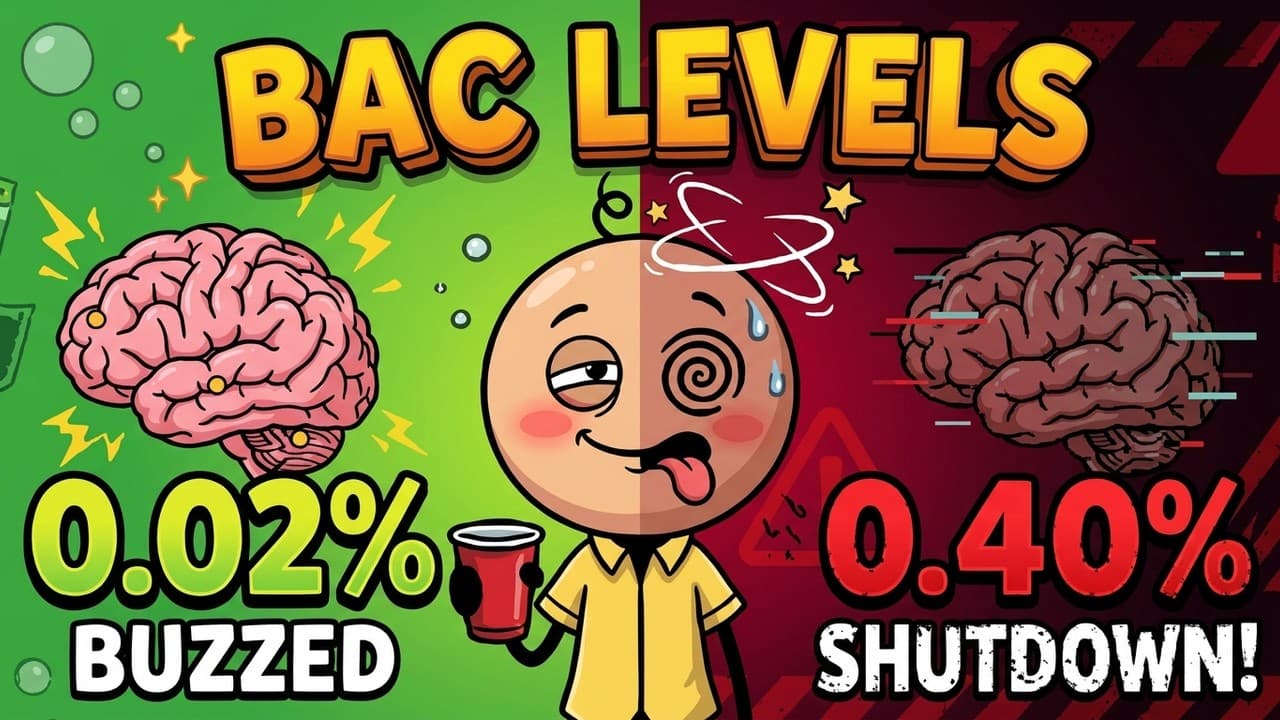
Being awake for 17 hours, so up at 7am and still up at midnight, tested like a blood alcohol level of 0.05. At 24 hours, the level two all-nighter, it was about 0.10, which is over the limit in every US state. If you want to see what those numbers look like with actual drinks, we go through the levels of being drunk one by one.
The other levels map on too. Drivers on four to five hours of sleep, which is level one, crash 4.3 times as often, and the AAA Foundation for Traffic Safety calls that similar to driving at the legal limit. Level four tested like up to two nights awake, past the point where the alcohol study stopped pouring. Levels five and six are off the chart.
On US roads in 2017, police reported 91,000 drowsy-driving crashes, about 50,000 people hurt and nearly 800 deaths. That's an undercount, because there's no breathalyser for tired. It isn't only drivers, either. Young doctors on 24-hour shifts made nearly 36% more serious medical errors.
So the boss was there from level one. By the all-nighter you were testing over the limit and calling it "just tired". As the video puts it, "Tired doesn't feel like drunk. It drives like it." The damage starts before you feel it, and only sleep pays it back. Aim for seven hours or more. If you've been up since breakfast and it's past midnight, treat yourself like a drunk friend and hand over the keys.
The short version
- One short night slows your reactions while making you feel upbeat, and caffeine only hides the sleep pressure.
- An all-nighter cuts memory for new things by 19% and makes the brain's alarm centre over 60% more reactive.
- Short nights stack, and a weekend lie-in fixes how sleepy you feel but not your reaction times.
- Two weeks of six-hour nights can leave you testing like someone who skipped up to two nights, mostly without noticing.
- At 17 hours awake you test like 0.05 blood alcohol, and at 24 hours like about 0.10. Get seven hours or more, and don't drive tired.
SOURCES
Every fact in the video comes from these.
- Van Dongen et al. 2003, Sleep: The cumulative cost of additional wakefulness (14 days of 4, 6 or 8 hours)
- Dawson & Reid 1997, Nature: Fatigue, alcohol and performance impairment
- NHTSA: Drowsy Driving
- AAA Foundation for Traffic Safety: Acute Sleep Deprivation and Risk of Motor Vehicle Crash Involvement
- Frenda et al. 2016, PNAS: Sleep deprivation and false confessions
- Harvard Gazette: Study shows importance of sleep for optimal memory functioning (Yoo et al. 2007)
- Waters et al. 2018, Frontiers in Psychiatry: Severe Sleep Deprivation Causes Hallucinations and a Gradual Progression Toward Psychosis
- NPR: Lessons from sleeplessness, the 60th anniversary of Randy Gardner's world record