What Happens If You Don't Sleep for 11 Days? Hour by Hour
21 October 202610:27 video6 min read
CHAPTERS
What happens if you don't sleep? Our cartoon guide Curly stays awake hour by hour to find out, from a perfectly normal hour 16 to day 11 and beyond.
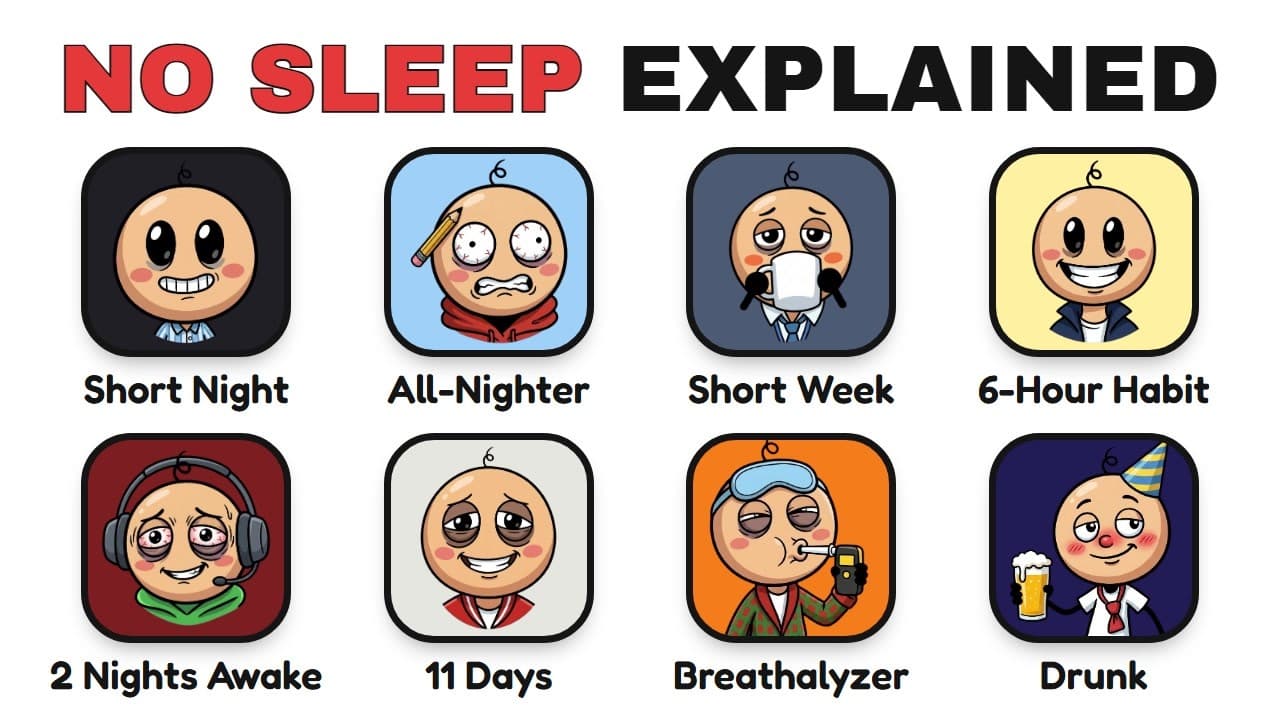
It's 11pm. Curly has been up since 7 this morning, and he's just decided he is never sleeping again, because sleep is apparently for people without Wi-Fi. This post follows his clock through ten stops, from a perfectly normal hour 16 to day 11 and beyond. He's doing this so you never have to, and the video is very clear that you shouldn't.
Hour 16: perfectly normal, for now
Adults need at least seven hours of sleep, so 16 hours awake is just an ordinary day. Underneath, though, a chemical called adenosine has been piling up in the brain all day. This is sleep pressure. Caffeine doesn't clear it. It only blocks the receptors that notice it, like muting your notifications while the inbox keeps filling up.
So why do you feel so wide awake? In the hours before bedtime, your body clock pushes hardest to keep you up, and scientists call this window the "forbidden zone" for sleep. Curly made his big decision at the exact hour he was least qualified to make it.
Hours 17 to 19: tipsy without a drink
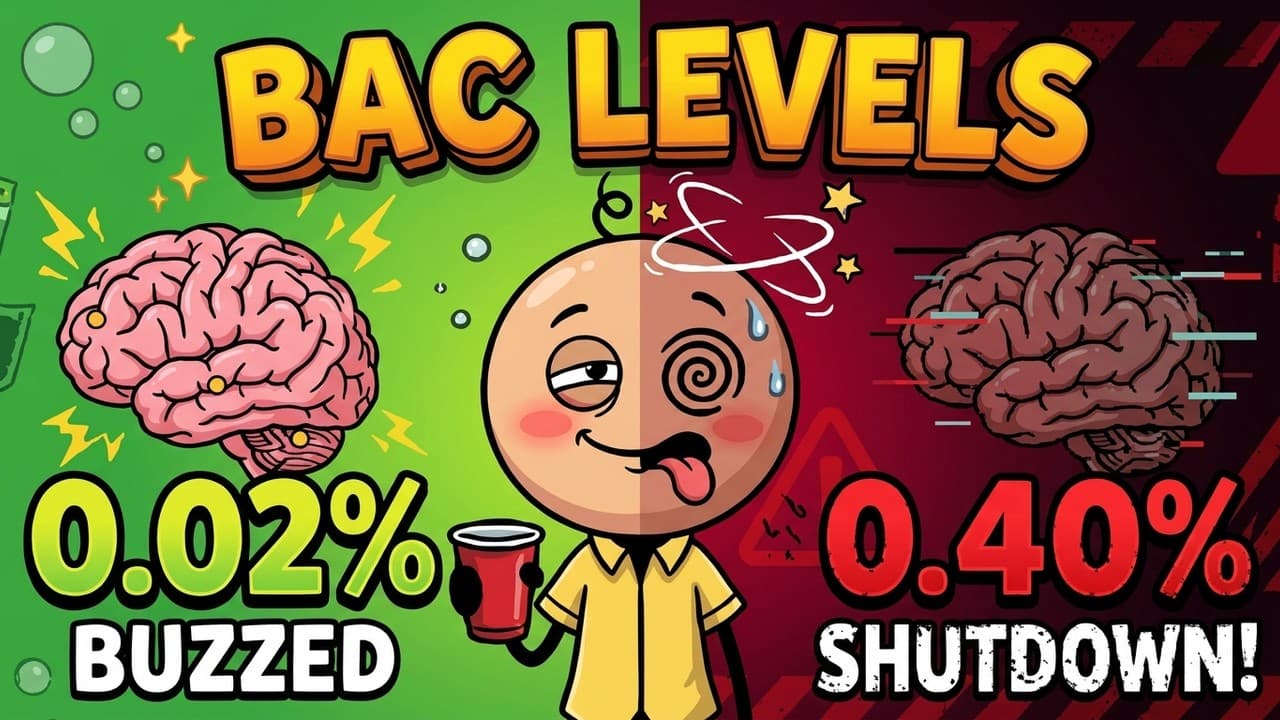
It's 1am. You've had nothing but water, and you're getting a little wobbly. In one study, 39 transport workers and soldiers were tested across 28 hours awake, and again after drinking alcohol. After 17 to 19 hours awake, on some tests, they did as badly as people at 0.05 blood alcohol, or worse. Their reactions were up to 50% slower.
0.05 is the legal driving limit in Utah, and you can reach it on tap water. That's one rung on the levels of being drunk, with none of the fun and all of the regret.
Hour 24: the all-nighter and the drive home
It's 7am. After a full day awake, people perform roughly like someone at 0.10 blood alcohol, which is over the limit in every US state. Worse, the brain starts napping without asking. Microsleeps last a few seconds, and people often don't notice them. In 12 patients kept up all night, scientists watched patches of the brain doze off while the rest stayed awake.
That's what makes the drive home so dangerous. First-year doctors coming off 24-hour shifts had over twice the odds of a crash and almost six times the odds of a near miss. In the US, crashes involving drowsy drivers killed nearly 30,000 people in five years. New parents will recognise some of this too, since new mums lose about an hour of sleep a night in the first three months.
Hour 36: the emotional wreck
At 7pm on day two you suddenly feel amazing, because the body clock perks up again in the evening. Then a dog food advert comes on and you're sobbing into your textbooks.
A Berkeley study shows why. People kept awake for about 35 hours looked at upsetting pictures in a brain scanner, and their amygdala, the brain's emotional alarm, was over 60% more reactive. Normally the front of the brain calms that alarm down. Without sleep, that link weakens. Memory suffers as well. After a night without sleep, students were up to 40% worse at saving new memories, so staying up to learn stops you learning.
Hour 48: where science stops
Two full days in, the scientists stop following. Keeping people awake past 48 hours is now considered unethical in research, and in most countries it's banned by law. Everything after this point comes from older experiments and record attempts.
The body is already glitching. When teenager Randy Gardner made his famous attempt, by day two he couldn't focus his eyes or recognise things by touch. If your own sleep loss comes in smaller nightly doses, short nights and six-hour habits get their own breakdown in the 7 levels of sleep deprivation.
Hour 72: seeing things
Three days in, Curly is creeping down the hallway with a torch because the coat rack just moved. Across 21 studies, by day three people were hallucinating in all three senses. Vision goes first, and 90% of the studies reported changes in what people saw. Objects that should be still seem to move, the floor gets darker, and a jacket can turn into a doll, a rock or even a person.
On day four, Randy Gardner's first hallucination was a street sign he took for a person. Seeing things is bad. Believing them is worse.
Days 4 to 5: the turning point
Around day five comes a sudden drop, known as the turning point. It looks like acute psychosis, and people start believing what they see. One volunteer was sure the others were plotting to stab him with a penknife. In another experiment, all 12 volunteers shared the same hallucination, an imaginary hat. Most group chats can't even agree on a pizza.
In 1959, DJ Peter Tripp stayed up for 201 hours, much of it in a glass booth in Times Square. He came to believe his doctor was an undertaker, although a sleep scientist later blamed the pills keeping him awake.
Day 11: Randy Gardner's 264 hours
San Diego, 1963. Seventeen-year-old Randy and his friends needed a science fair project, and Randy lost the coin toss. He stayed awake on Coca-Cola, loud music and cold showers. Stanford sleep scientist William Dement kept him busy with pinball, and on day 10 Randy was still beating him.
On day 11 he was asked to count back from 100 in sevens. He got to 65 and stopped, because he'd forgotten what he was doing. His face went blank, his speech slurred, and Dement later accepted he'd probably had microsleeps. Randy then slept about 14 hours, woke up feeling pretty normal, and the team won first place. Decades later he developed insomnia, which he called karmic payback. Guinness stopped monitoring the record in 1997 because of the dangers.
Weeks 2 to 3: what the rat experiments showed
The Russian sleep experiment never happened. It's an internet horror story. The real experiments were on rats, in Allan Rechtschaffen's sleep lab at the University of Chicago.
Each rat lived on a disc over water. Whenever it dozed off, the disc turned and it had to keep walking to stay dry. In one study, all 10 rats died, or were put down near the end, within 11 to 32 days. They ate more and still lost weight, burning over twice their normal energy. Their body temperature dropped, and the scientists couldn't find a single organ to blame. Rechtschaffen's verdict was that if sleep isn't absolutely vital, it's the biggest mistake evolution ever made.
Fatal familial insomnia: when nobody gets a choice
Everyone else on this clock chose to stay up. Nobody chooses this one. Fatal familial insomnia is a rare inherited prion disease. A faulty gene makes an abnormal protein that builds up in the thalamus, a brain hub that helps run sleep. It starts as insomnia that keeps getting worse, then brings panic and hallucinations, until people can't sleep at all.
On average it begins around age 45 to 50. Average survival is about 18 months, and there's no cure. Each child of a carrier has a 50% chance of inheriting it, and about 70 families worldwide are known to carry it. Randy bounced back after one long sleep. Here the brain's own sleep machinery breaks, and there's no catching up.
There is hope. Sonia Vallabh watched her mother die of the disease, then learned she carries the same gene change. She and her husband, Eric Minikel, retrained as scientists and now study prion disease at the Broad Institute. In 2024, a gene-silencing tool cut prion protein by up to 80% in mice, and a drug designed to lower it is being tested in people, with results expected around 2027.
The short version
- Around 17 to 19 hours awake, people can test as badly as at 0.05 blood alcohol, and after a full day awake it's roughly 0.10.
- Microsleeps start after an all-nighter, often unnoticed, which makes the drive home risky.
- By day three people hallucinate, and around day five many start believing what they see.
- The fix is free. Get seven hours, never drive drowsy, and see a doctor if you can't sleep most nights.
SOURCES
Every fact in the video comes from these.
- Williamson & Feyer 2000, Occupational and Environmental Medicine: moderate sleep deprivation vs. alcohol intoxication
- Waters et al. 2018, Frontiers in Psychiatry: severe sleep deprivation causes hallucinations and a gradual progression toward psychosis
- NPR 2024: Randy Gardner and the sleep deprivation record
- Guinness World Records 2023: What's the limit to how long a human can stay awake?
- UChicago News 2021: Allan Rechtschaffen, sleep research pioneer
- NORD: Fatal familial insomnia
- UC Berkeley via ScienceDaily 2007: sleep loss and the emotional brain