How Long Would You Survive in History? 10 Eras Explained in 10 Minutes
19 October 20269:44 video6 min read
CHAPTERS
How long would you survive in every era of human history? One very soft modern human, 10 eras from the Stone Age to today, and real numbers on your odds.
Take one very soft modern human, with a phone and a pot of probiotic yoghurt, and drop them into ten eras of history. How long would they last? Each era below gets a score out of 10 on a survival meter. One warning first. A life expectancy of 30 never meant everyone dropped dead at 30. Half of all children died, which drags the average way down, and plenty of people made it to a cranky 70.
The Old Stone Age: survive childhood, and you might reach 70
From 300,000 to 12,000 years ago, life was a gym with no membership fee, where the treadmill is lunch and lunch can run faster than you.
Based on modern hunter-gatherers, life expectancy was about 30, and about half of all children died. The big killers were infection, violence and accidents. Even a small cut could finish you, and antibiotics didn't arrive until 1928. Dodge all that, though, and the most common age for adults to die was around 70.
Survival meter: 5 out of 10. The Stone Age wasn't short. It was front-loaded. For what people were inventing in the meantime, see every prehistoric invention explained.
The first farmers: humanity's first bad career move
From about 10,000 BC, people swapped roaming and snacking for bending over a field all day. Their bread was ground on stone, so it came with bonus stone.
Life expectancy stayed around 20 to 30, and half of children still died. The big killer was germs, from living nose to nose with animals. Skeletons got shorter and sicker. At Çatalhöyük, over a quarter of skulls had healed head wounds, mostly from behind. So, the neighbours.
Survival meter: 3 out of 10.
Building the pyramids on bread, beer and worms
Egypt, about 2600 BC. Your boss hands you a stone block and asks for 2.3 million of them. The Greek historian Herodotus claimed 100,000 forced workers built the pyramids. Archaeologists think it was more like 20,000, fed on bread and beer.
The bread had sand in it, which wore Egyptian teeth right down. The Nile added worms. In one study, nearly half the mummies tested had blood flukes. Life expectancy was 20 to 35. Nearly a quarter of the Giza workers' cemetery is children, and workers died about 10 years earlier than nobles.
Survival meter: 3.5 out of 10.
Ancient Rome: a lottery you had to win twice
Rome in the 1st century AD was a city of a million. Picture a top-floor flat where your fire alarm is the neighbour carrying his furniture out.
Life expectancy was 20 to 30. Historians estimate that half of Romans died before they turned 10. Make it to 10, though, and you'd likely see 45 or 50. The big killer was disease, such as malaria.
Public baths didn't save you either. Under the Romans, worms didn't go down at all, and some bath water was rarely changed.
Survival meter: 4 out of 10.
The year 536, when someone turned the sun down
Imagine your weather app showing one sad grey cloud for 18 months. A volcano, probably in the far north, filled the sky with haze. The writer Procopius said the sun shone like the moon. Summers got up to 2.5 degrees colder, and it snowed in China in summer. Harvests failed. Irish chronicles called it a failure of bread.
Historian Michael McCormick says 536 may have been the worst year to be alive. Then, in 541, plague arrived. McCormick says it killed a third to a half of the Eastern Roman Empire, while others say far fewer. In normal years, life expectancy was 30 to 40.
Survival meter: 1 out of 10. Modern know-how can't fix the sky. McCormick's runners-up for worst year were 1349 and 1918, and both are coming up.
The Black Death: there was no mild case
From 1347 to 1352, a germ sailed in from the Black Sea, in fleas, on rats, on ships. In five years it killed a third to a half of Europe, roughly 25 to 50 million people. Untreated, the bubonic kind killed up to three in four victims, often within three days. Even before it hit, life expectancy was 30 to 40 and half of children never grew up.
If you're worried that washing your hands will get you called a witch, relax. The big witch hunts are 200 years away. Paris's top doctors will just blame bad air and warn against too much bathing, in writing. The one good idea came from Dubrovnik, which made arrivals wait 30 days, later 40. Forty in Italian is quaranta, and that's where quarantine comes from. We go deeper into all of this in how brutal 14th-century survival was.
Survival meter: 1.5 out of 10. Knowing about fleas helps, but not much.
The Age of Sail, where dinner was the enemy
Between 1500 and 1800, life at sea was a job where the enemy barely mattered. By one estimate, four in five navy deaths came from disease or accidents. The most notorious was scurvy, caused by one missing vitamin, which killed an estimated 2 million sailors.
Dinner was ship's biscuit, often full of weevils. Finally, bread with protein. In 1747 James Lind showed that oranges and lemons worked. The navy took 48 years to listen. On land, life expectancy was 30 to 40, and in Sweden four in 10 children died before 15.
Survival meter: 2.5 out of 10, and packing lemons is worth a whole point of that.
The Industrial Revolution: at the mill, aged nine
In Britain in the 1830s to 1850s, you could start at the mill aged nine. The law said children that age could only work nine hours a day, and that was the reform. The smallest children crawled under running machines to sweep up fluff, and many got hurt.
England's life expectancy was about 40, and about one baby in seven died before turning one. In 1842, the average age at death for Manchester labourers was 17. For rural gentry it was 52. The big killer was disease in crowded towns, like cholera in the water.
Meanwhile in Vienna, Dr Ignaz Semmelweis made his doctors wash their hands, and deaths of new mothers fell from about 18% to 1 or 2%. Other doctors weren't interested.
Survival meter: 4.5 out of 10. In a cholera year, boiling your water is a superpower.
The trenches and the 1918 flu: the surprise runner-up
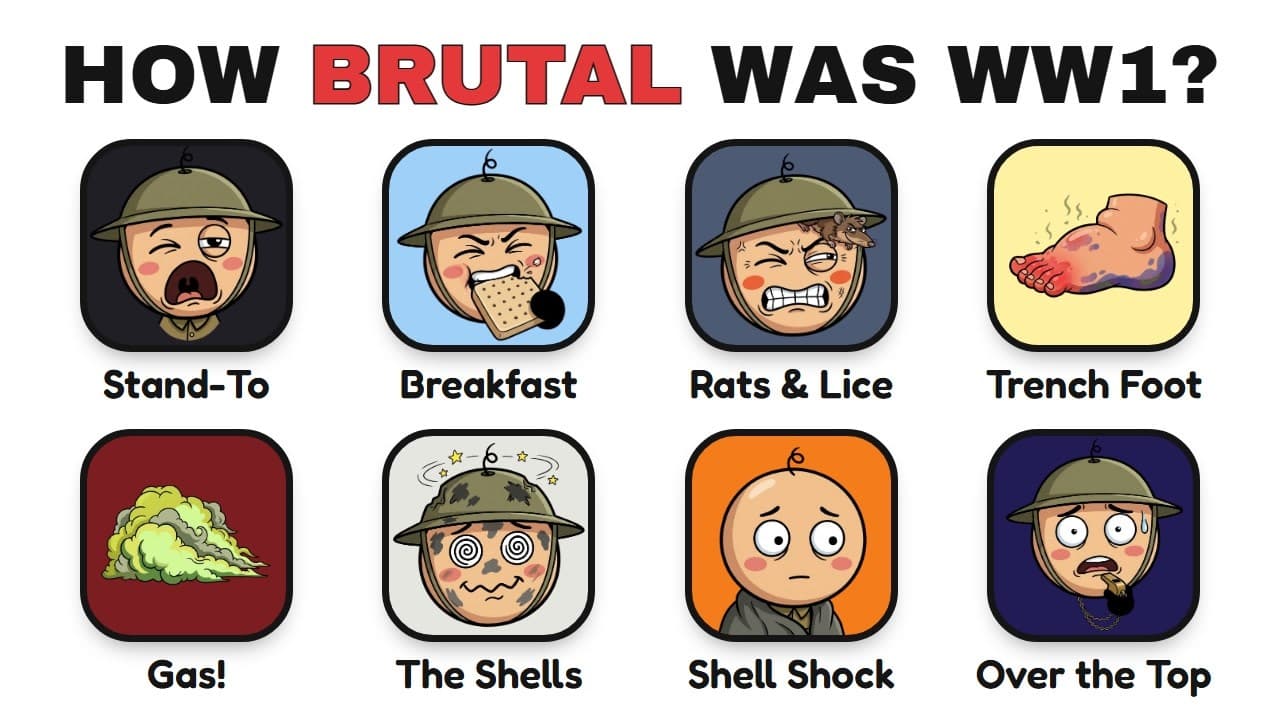
From 1914 to 1919, home is a muddy ditch where nearly everyone has lice, 95% in one army study. Wet feet swelled and went numb, which is trench foot. The fix was dry socks and whale oil.
About 8.5 million soldiers died. In the British Empire's forces, that was about 1 in 10. Then the flu killed at least 50 million people, and it hit healthy 20 to 40-year-olds hardest. American life expectancy went from 51 in 1917 to 39 in 1918, then up to 55. A ski jump. About one American baby in 10 died before turning one. The official flu advice was good hygiene, 71 years after Semmelweis.
The twist is that this era beats everything before it. Nine in 10 British soldiers came home, even with penicillin a generation away.
Survival meter: 5.5 out of 10.
Today: nine out of ten, depending on where you're born
In 2026, life expectancy is about 73. Instead of half of all children, about four in a hundred die. The thing most likely to get you now is your own heart, slowly. Heart disease causes one death in six.
Where you're born still matters. Life expectancy is about 52 years in Chad and 86 in Japan.
Survival meter: 9 out of 10.
The short version
- The worst era was 536, at 1 out of 10, with the Black Death close behind at 1.5.
- The best era is today, by a mile, at 9 out of 10.
- The surprises were the trenches and 1918 flu in second place, and the Old Stone Age in third.
- Low life expectancy figures mostly reflect child deaths. The average said 30, and plenty of grandmothers said otherwise.
- Cheap fixes worked long before anyone listened. The navy took 48 years to act on lemons, and official hygiene advice came 71 years after Semmelweis.
SOURCES
Every fact in the video comes from these.
- Science (2018): Why 536 was 'the worst year to be alive'
- Our World in Data: Child mortality in the past
- Gurven (2024): Lifespan and Mortality in Hunter-Gatherer and Other Subsistence Populations, Cambridge University Press
- World History Encyclopedia: Black Death
- Sutton (2003) on James Lind's scurvy trial, Journal of the Royal Society of Medicine
- CDC: 1918 Pandemic (H1N1 virus)